 Solo Work Tools
How much should a handyman charge per hour?
A solo handyman should charge enough per billable hour to cover take-home pay, business costs and self-employment tax: (take-home goal + yearly costs + SE tax) ÷ billable hours. With a $55,000 goal, $10,272 of costs and 1,200 billable hours, that is about $60.87 an hour before profit.
rate = (goal + costs + SE tax) ÷ billable hours
Why so much more than a wage? The Bureau of Labor Statistics put the median pay for general maintenance and repair workers at $23.84 an hour in May 2025. An employee at that wage is paid for about 2,080 hours, and the employer covers the truck, tools, insurance and half of payroll taxes. On your own, you pay all of those, and you only bill for the hours you're on a job.
The hourly number your customer sees has to carry the hours they never see: driving, quoting, buying materials and chasing payment.
Handyman hourly rate calculator
Vehicle cost uses the IRS business standard mileage rate of 76 cents a mile for July 1 to December 31, 2026 (it was 72.5 cents for the first half of the year), per the mid-year IRS update, as a stand-in for fuel, wear and insurance on the truck. SE tax is estimated as 92.35% × take-home goal × 15.3%; income tax is not included.
Where a $60 hour actually goes
In the $60.87 example, $45.83 is your take-home, $8.56 covers costs ($10,272 ÷ 1,200 hours) and $6.48 covers self-employment tax ($7,771.25 ÷ 1,200). The IRS's Topic 554 explains that SE tax is generally figured on 92.35% of net earnings at 12.4% Social Security plus 2.9% Medicare, and half of it is deductible.
About a quarter of every hour you bill is spoken for before you get paid.
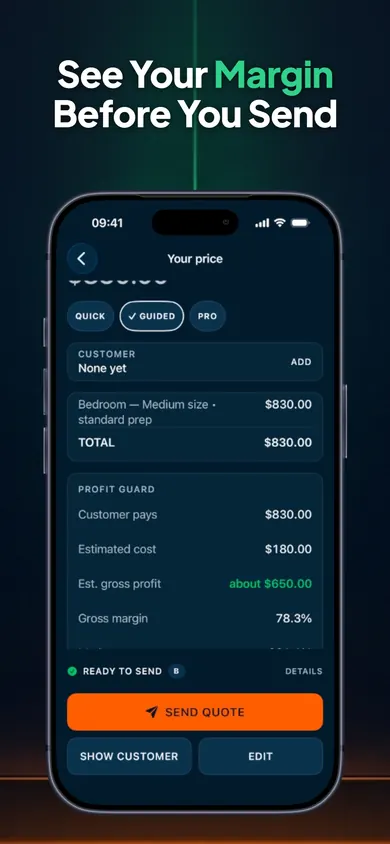
See the margin before you send
How to use your rate on every quote
- Set an hourly line item at your number. ScopeBid supports hourly, per-unit, crew and area line items, plus trip charges and minimums in a local price book.
- Price cost first when you're unsure. Enter labor and materials and ScopeBid suggests a price; Profit Guard shows the estimated gross margin, and a discount shows its effect before you send.
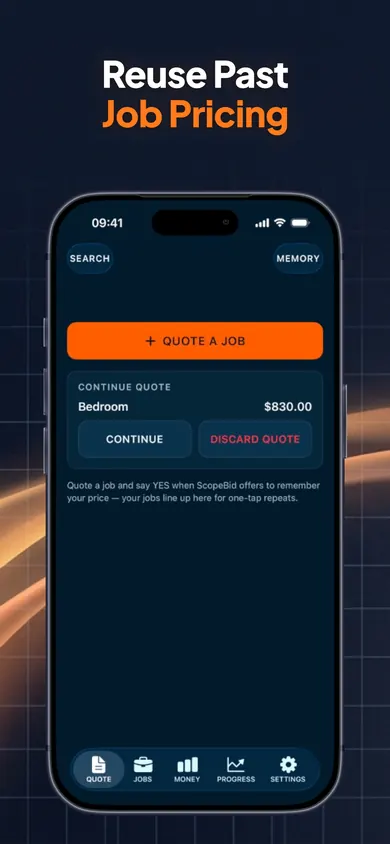
- Close out in ten seconds. Enter actual labor and materials after the job. Quoted vs actual feeds Business Memory, so the next similar quote starts from what really happened.
A rate only works if it reaches the quote. Saving it as a line item is how it does.
Who should use something else
- If you need card payments processed, ScopeBid records payments but does not process cards or move money.
- If you need bookkeeping or tax filing, use accounting software. ScopeBid is an estimating and invoicing tool, and you set your own tax rates.
- If you run a crew with payroll, this calculator is for one person's hours; a crew needs burden rates per worker.
- If you only take a few side jobs a year, a spreadsheet and this page may be all you need.
Hourly, flat rate or minimum?
| Pricing style | Best for | Watch out for |
|---|---|---|
| Hourly at your rate | Repairs with unknowns: leaks, rot, old wiring behind a plate | Customers watching the clock; agree a cap or check-in point |
| Flat price per task | Repeat jobs: TV mounts, door swaps, faucet installs | Price it from your rate × your real time, not a guess |
| Trip charge or minimum | Small calls where drive time beats work time | State it in the quote before you go out |
One licensing note for California: since January 1, 2025, unlicensed work is capped at $1,000 per job and can't need a permit, under CSLB's AB 2622 bulletin. Other states set their own limits.
Handyman rate questions
How many billable hours does a solo handyman have?
Fewer than you think. Driving, quoting, buying materials and invoicing all eat the week. Our example uses 25 billable hours a week across 48 weeks, or 1,200 hours a year. Track a month of your own weeks to replace that guess.
Should I include self-employment tax in my rate?
Yes. The IRS says SE tax is 12.4% Social Security plus 2.9% Medicare, generally on 92.35% of net earnings. An employer would pay half of that for an employee; on your own, your rate has to cover all of it.
How do I price drive time?
Either fold it into your hourly rate, as this calculator does with the IRS business standard mileage rate of 76 cents a mile for July 1 to December 31, 2026 (it was 72.5 cents for the first half of the year), or add a trip charge on each quote. Do one or the other, not both.
Is my calculated rate my price?
It is your floor. Add a profit cushion for slow months, then compare with what local customers will pay. If the market won't pay your floor, raise billable hours or cut costs before cutting the rate.
Put your rate into the next quote
Save it as an hourly line item, see the margin before you send, and let real jobs correct the number over time. Your first 3 quotes are free, with full PDFs.
More free tools and guides
- Estimate vs quote vs bidAn estimate is a best guess, a quote is a fixed price once accepted, a bid competes for a job. Tick 4 facts about your job to see which to send.
- How to bid a landscaping jobHow to bid a landscaping job without leaving money in the truck: tick six cost lines, watch the price change, then run your own job in the free calculator.
- Markup vs margin for contractorsMarkup is profit over cost; margin is profit over price. A 30% markup is only a 23% margin. Sort real quotes, check discounts and convert either way.
- Best estimate app for paintersBest estimate app for painters? We compared ScopeBid (ours), Joist and Paint Estimator Pro from their App Store listings, Nov 2026. Fair picks by job type.