What is the formula for markup?
Markup equals profit divided by cost, times 100. A $1,000 cost sold at $1,300 has $300 profit, so the markup is 300 ÷ 1,000 = 30%.
 Solo Work ToolsPricing FAQ
For painters, cleaners and handymen quoting alone. Drag four quotes into best-margin order.
Updated November 2026 · By the Honest Little Apps studio · 12 questions, 8-minute read
Markup is profit divided by your cost. Margin is profit divided by the customer's price. On a job that costs you $1,000 and sells for $1,300, the $300 profit is a 30% markup but only a 23.08% gross margin. Margin is always the smaller number, and it's the one that tells you how much of each dollar you keep.
Mark up your cost, but judge the job by its margin.
About 31 percent of construction and maintenance painters are self-employed, according to the BLS Occupational Outlook Handbook (last modified August 2026). Quoting alone means nobody checks your percentages but you. The twelve answers below cover the questions solo trades ask most.
Type a cost and a markup, or a target margin. Everything is worked out here in your browser.
Sales tax isn't included. It's collected for the government, not profit.
| Markup | Gross margin | Markup needed for this margin |
|---|---|---|
| 20% | 16.67% | 25.00% for 20% |
| 25% | 20.00% | 33.33% for 25% |
| 30% | 23.08% | 42.86% for 30% |
| 50% | 33.33% | 66.67% for 40% |
| 100% | 50.00% | 100.00% for 50% |
Markup equals profit divided by cost, times 100. A $1,000 cost sold at $1,300 has $300 profit, so the markup is 300 ÷ 1,000 = 30%.
Gross margin equals profit divided by the price, times 100. The same job is 300 ÷ 1,300 = 23.08%. Same dollars, smaller percentage, because the price is a bigger number than the cost.
Divide the markup by one plus the markup. A 30% markup is 0.30 ÷ 1.30 = 23.08% margin. A 100% markup, doubling your cost, is a 50% margin.
Divide your cost by one minus the target margin. For a 30% margin on a $1,000 cost, charge 1,000 ÷ 0.70 = $1,428.57. Marking up 30% gives only $1,300.
Because the discount comes straight out of profit. Cut a $1,300 price by 10% to $1,170 and your profit falls from $300 to $170, a 14.53% margin. The customer saved $130; you lost 43% of your profit.
No. IRS Publication 334 (2025) says state and local sales taxes imposed on the buyer that you were required to collect and pay over to state or local governments are not income. Leave them out of every margin calculation.
Use both, for different jobs. Markup is handy for building a price from cost, line by line. Margin is better for comparing jobs and setting a floor, because it tells you what share of every dollar you keep. Decide your minimum margin first, then convert it to the markup you apply.
Not always. In the sorter above, the $3,200 kitchen repaint earns the most dollars ($640) but the lowest margin (20%). The $900 door job keeps 35%. Bigger jobs tie up more days for each dollar of profit.
The labour and materials for that specific job: your hours at the rate you pay yourself or a helper, paint, supplies, dump fees, trip charges. Overheads like insurance and your phone come out of gross profit afterwards.
There's no single honest number; it depends on your trade, area and overheads. Work it backwards: add up a year of overheads plus the pay you want, divide by expected sales, and that's the minimum margin your jobs need to average.
Usually not. Your quote shows the price and scope. Your cost and margin are your business numbers, the same way a shop doesn't print its wholesale price on the tag.
Compare quoted cost with actual cost after every job. If actual labour keeps running over, your future quotes need more hours, not a bigger markup on the wrong hours.
If you bid commercial work with bonding, retainage and multi-trade subcontractors, you need construction estimating and accounting software, not a phone quoting app. If you want a tool that processes card payments or does your bookkeeping and taxes, ScopeBid isn't that either: it records payments but doesn't move money, and you set your own tax rates.
We built ScopeBid's Profit Guard to answer question 7 before you hit send. It shows customer price, direct cost, estimated gross profit, gross margin and markup, clearly separated, and sales tax is never counted as profit. Enter a discount and you see exactly how it changes your estimated gross margin.
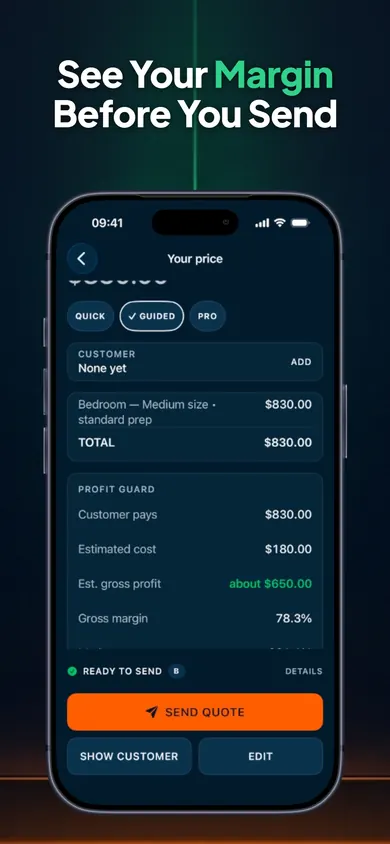

One design decision we'd defend: internal cost and margin are never printed on customer documents. The honest limits: your first 3 quotes are free with full PDFs; unlimited quoting, the full Business Memory, job costing and invoicing need ScopeBid Pro, a monthly or annual subscription. Profit Guard is only as good as the costs you enter.
A solo painter quotes a $1,300 bedroom-and-hall job on $1,000 of labour and paint, thinking of it as "30% on top." The homeowner asks for 10% off and gets it. The invoice is $1,170 and the profit $170, not the $300 he'd pictured.
Next time he sets a 30% minimum margin, prices the same job at $1,428.57, and has room to give a small discount without working half the week for free. An illustration, with the math checked above.
Quote from a saved job, check Profit Guard, send a clean PDF. Works offline, no account.