 Solo Work ToolsFor landscapers
Your bid isn't high. It's missing lines.
For landscapers pricing a one-off install. Tick each cost you'd put in your quote and watch the price.
Updated November 2026 · By the Honest Little Apps studio · Sample numbers, checked in code
How do you bid a landscaping job?
Add up every direct cost of the job (crew hours on site, materials, disposal, drive time and mileage, equipment wear), then divide that total by one minus your target gross margin. A $586.44 job at a 35% margin is $586.44 ÷ 0.65 = $902.22. Most low bids aren't cheap on purpose; they skip a line.
That's the whole method. The hard part is remembering the lines when a homeowner is standing in the driveway asking for a number. The checklist above is a real-shaped example: a mulch refresh with six shrubs, two people, five hours on site. Labor plus materials looks like a quote, but it's only half of one.
A landscaping bid is direct cost divided by one minus your margin, and every line you forget comes out of your pay.
Run your own job: landscaping bid calculator
Change any number. The table rebuilds the bid line by line, the same way you'd explain it to a customer who asks why.
| Line | Amount |
|---|
Where the defaults come from: the $0.76 per mile is the IRS business standard mileage rate for July 1 to December 31, 2026, listed on the IRS standard mileage rates page. It's a reasonable stand-in for what a truck costs to run per mile; your own fuel, insurance and repair numbers are better if you track them. The $22 labor cost is our example, not a wage you should pay or charge.
For context, the Bureau of Labor Statistics' Occupational Outlook Handbook puts the median pay of grounds maintenance workers at $19.27 an hour (May 2025), and that figure leaves out the self-employed. If you're solo, your labor line also has to cover what an employer would: the IRS says the self-employment tax rate is 15.3% for Social Security and Medicare.
Price the drive and the dump run like any other line, because the customer's job is the reason they happen.
What the same bid looks like in ScopeBid
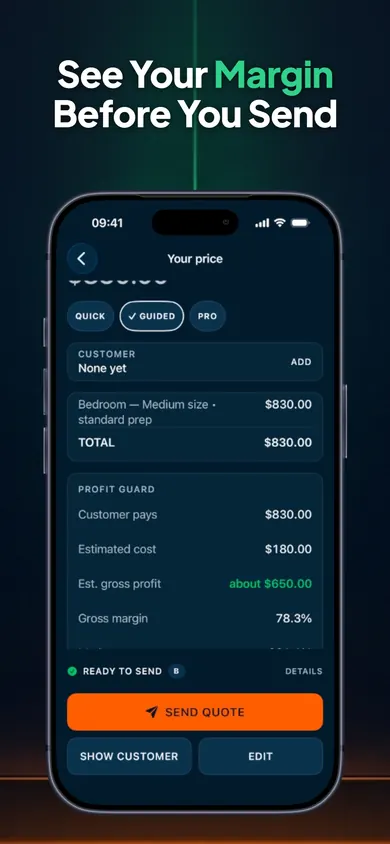
We built ScopeBid for small service crews, landscapers included. Cost first: enter labor and materials and it suggests a price. Profit Guard then shows customer price, direct cost, estimated gross profit, gross margin and markup, kept apart, and sales tax is never counted as profit.
Ways landscapers price a job
Gut number
Fast in the driveway. Misses the dump run and the drive more often than not.
Notebook or spreadsheet
Free and flexible. You rebuild the lines each time and do the margin math yourself.
Online estimate tools
Good starting ranges, but they don't know your crew, truck or supplier prices.
ScopeBid (ours)
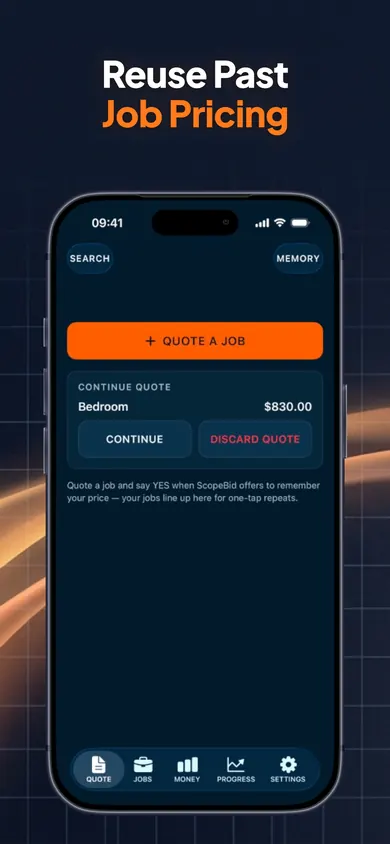
Saves each job's rates, hours and materials, so the next quote starts from a real past job. Works with no signal.
The method that wins is the one that remembers your last job's real numbers.
How to price a landscaping job in ScopeBid, in 3 steps
Start from a past job or a template
Pick a saved job, a trade template or a blank quote. Area and per-unit line items take your own units, so mulch by the yard and edging by the foot both work.
Check profit, then send
Profit Guard shows gross margin and markup side by side. Enter a discount and see exactly what it does to your margin before you agree to it. Send a clean PDF; your internal cost is never printed on it.
Close out in ten seconds
After the job, enter actual labor and materials. Estimated vs actual feeds Business Memory, so the next similar quote is closer to the truth.
The honest limits. ScopeBid doesn't know your local prices or tell you what to charge; it does the arithmetic on numbers you enter. It records payments but doesn't process cards, and it isn't accounting or tax software. Your first 3 quotes are free with full PDFs; unlimited quoting and the full Business Memory, job costing and invoicing workflow are part of ScopeBid Pro, a monthly or annual subscription.
Pick something else if you run recurring weekly mowing routes with dispatching and online payments; a full field-service platform fits that better. ScopeBid is for quoting and invoicing one job at a time, on your phone.
Landscaping bid questions
What margin should a landscaping job have?
There's no official number. Pick a target gross margin that covers your overhead (insurance, phone, software, slow weeks) and leaves profit. This page uses 35% as an example; at 35%, every $100 of direct cost becomes a $153.85 price.
Is a 35% margin the same as a 35% markup?
No. A 35% gross margin on price equals a 53.8% markup on cost. Adding 35% to cost gives only a 25.9% margin, which is why bids built on markup often come in lower than intended.
Should I charge for drive time on a landscaping quote?
Build it into the price, either as its own trip charge line or inside labor. In the example, 0.8 hours of drive for two people plus 24 miles costs $53.44 before margin. Leave it out and you pay it yourself.
Should I bid landscaping by the hour or by the job?
Most homeowners prefer one price for the job. Work it out from hours anyway, so you know what the fixed price has to cover. If the scope is unclear, quote the known part and add extra work as a change order.
Bid the next job with every line in it
Start from a real past job, check your margin, send a PDF from the driveway. Open ScopeBid in the App Store; the first 3 quotes are free.
More free tools and guides
- Markup vs margin for contractorsMarkup is profit over cost; margin is profit over price. A 30% markup is only a 23% margin. Sort real quotes, check discounts and convert either way.
- Best estimate app for paintersBest estimate app for painters? We compared ScopeBid (ours), Joist and Paint Estimator Pro from their App Store listings, Nov 2026. Fair picks by job type.
- Cleaning business scheduling checklist12 checks to run before you text a cleaning client "you're booked", plus a day planner that shows how many jobs really fit once you add buffers and drives.
- Dog grooming no-show policyBuild a dog grooming no-show policy in 2 minutes: see what missed grooms cost a year, pick a deposit and notice window, and copy the wording.