
ScopeBid iconSolo Work ToolsDeposits

Updated November 2026 · Checked against state sources

When the Customer Asks "How Much Down?"

For contractors pricing home jobs: tap your state, see the deposit cap, then size it to materials.

Tap your state. Home improvement deposit caps differ a lot, from $1,000 to a third of the job.

Download on the App StoreFree on iPhone · Start on your iPhone

How much deposit should a contractor ask for?

Ask for enough to cover the materials you must buy before day one, and never more than your state allows. In California that cap is $1,000 or 10% of the contract price, whichever is less. Maryland caps it at one-third. Everything after the deposit should follow work actually done.

That last point comes straight from the California Contractors State License Board's payment rules sheet: never take a progress payment "larger than the value of the work completed." It is a good habit even where no law says so, because it keeps you and the customer level for the whole job.

Short version: deposit = up-front materials, capped by state law; progress payments = work done; final payment = finished punch list.

Deposit checker: cap, deposit and payment stages

Enter the job. We take the smaller of your up-front materials and your state's cap, then split the rest into the stages you choose. All math runs on this page.

Deposit to ask for$890.00

A planning aid, not legal advice. Caps here are for residential home improvement contracts; check your licensing board for your job type.

Decision chart: is your deposit the right size?

Answer each step. The thread stops where the problem is.

Is the job home improvement work for a homeowner?

Is your deposit at or under your state's cap?

Does it roughly match materials you buy before starting?

Is every later payment tied to finished work, in writing?

What this page can't tell you

  • Every state's rule. We checked three states against their own sources in November 2026. Many states have their own home improvement laws, and some have none on deposits. Look up your state's contractor licensing board before you send a contract.
  • Commercial and new-construction work. The caps above are written for home improvement contracts with owners. Commercial jobs usually follow the contract you negotiate.
  • Tax and accounting. ScopeBid records deposits and payments; it does not process cards or move money, and it isn't accounting or tax software.
StateDeposit ruleSource
California$1,000 or 10% of contract price, whichever is less; no special-order exceptionCSLB
MarylandNot more than one-third of the contract priceBus. Reg. §8-617
MassachusettsThe greater of one-third or the cost of special-order or custom materialsc.142A §2

An $8,900 bathroom refresh, three ways
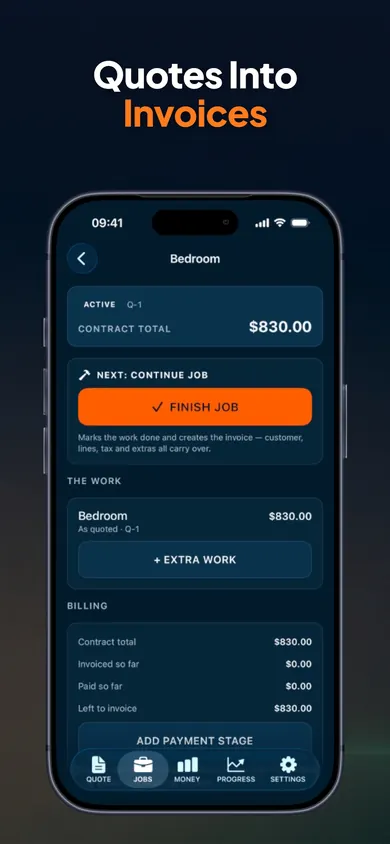
ScopeBid active job screen with contract total, Extra Work button and a billing summary with an Add Payment Stage button

A tile-and-vanity job is priced at $8,900, with $2,400 of tile and fixtures to buy before demolition. Same job, three states, worked out in code:

  • California: cap is $890 (10% is less than $1,000). Ask $890, then two progress payments of $4,005.
  • Maryland: cap is $2,966.67. Ask $2,400 to match materials, then two payments of $3,250.
  • Massachusetts: cap is at least $2,966.67. The same $2,400 deposit fits, with $3,250 twice after.

In California, $1,510 of those materials comes out of the contractor's pocket until the first progress payment. That's why the first stage should land early, at a point the customer can see, like "demo done and tile delivered".

How to set deposits in ScopeBid in 3 steps

  1. Build the quote. Start from a saved job, a trade template or a blank quote, and price it first or cost it first.
  2. Add the deposit and payment stages. ScopeBid supports tax, discounts, deposits and payment stages on the quote, and Profit Guard shows margin before you send.
  3. Record what comes in. Log deposits and partial payments received by cash, cheque, e-transfer, bank transfer or a card terminal, and track the balance as the job moves to invoice.

Your first 3 quotes are free, with full PDFs.

Contractor deposit questions

Is 50% down normal for a contractor?
It is common to hear, but it is illegal for home improvement work in California, where the cap is $1,000 or 10%, and above the one-third limit in Maryland. Check your state first, then size the deposit to up-front materials.
Can a California contractor take more for special-order materials?
No. The CSLB says there are no exceptions for special-order materials. Massachusetts is different: its law allows a deposit up to the cost of special-order or custom materials when that is more than one-third.
Should a small job have a deposit at all?
If you buy nothing in advance, you can skip it and bill on completion. A deposit makes most sense when you must order materials or hold a date on your calendar.
What should the payment schedule say?
Name each payment, its amount and the finished work that triggers it. The CSLB says a home improvement contract must have a detailed, written payment schedule.

Deposit strategies compared

ApproachUpsideCatch
Flat percentageEasy to explainCan break a state cap on bigger jobs
Materials-basedMatches your real cash outNeeds a materials list before you quote
No deposit, bill on completionFast yes from customersYou carry every cost until the end

Materials-based deposits under the cap are the easiest to defend to customers and regulators alike.

Put the deposit on the quote, not in a text

Quote, deposit, payment stages and balance in one place, even with no signal. Who should pick something else: if you need card processing or full accounting in the same app, an all-in-one field service system will suit you better.

Download on the App StoreFree on iPhone · Start on your iPhone

More free contractor tools