 Solo Work Tools
Overnight shift hours calculator
The break is taken out of the hours before midnight first when the workweek is split. Pay shown is gross, before taxes and deductions.
How do you calculate overnight shift hours?
To calculate overnight shift hours, count the time from clock-in to midnight, add the time from midnight to clock-out, then subtract any unpaid break. For 11 PM to 7 AM with a 30-minute unpaid break, that's 1 + 7 − 0.5 = 7.5 hours. Add one hour if the clocks fell back during the shift, and take one off if they sprang forward.
The clock-change rule follows the plain idea that pay is owed for actual time worked. A National Law Review analysis gives the same example: a third-shift worker scheduled 11 p.m. to 7 a.m. on the fall-back night works 9 hours, and all 9 count toward the 40-hour overtime threshold. NIST lists the 2026 change dates as March 8 and November 1, at 2 a.m.
Count real elapsed time, not the difference between two clock faces.
Overnight shift questions
Does an overnight shift count on the day it starts or ends?
For overtime, what matters is the workweek. US federal rules (29 CFR 778.105) define a workweek as a fixed, recurring 168-hour period that can start on any day and at any hour. If your workweek begins at midnight Sunday, a Saturday night shift is split: hours before midnight go to one week, hours after go to the next.
Do I get overtime for working nights?
Not just for the time of day. The US Department of Labor says the federal law requires 1.5 times the regular rate for hours over 40 in a workweek, and does not require extra pay for night or weekend work. A night premium comes from your employer's policy or agreement.
How do I convert minutes to decimal hours?
Divide the minutes by 60. Thirty minutes is 0.5, fifteen is 0.25, and forty-five is 0.75. The table on this page lists common values to two decimal places.
What happens to overtime on the fall-back night?
The extra hour counts like any other. Five nights of 8.5 hours is 42.5 hours. If one of them is the fall-back night, the week is 43.5 hours, so 3.5 overtime hours instead of 2.5.
Is an unpaid meal break always unpaid?
Only when you're fully relieved from duty. The Department of Labor's hours-worked fact sheet says bona fide meal periods generally need not be paid when the employee is completely relieved. If you eat at your station and answer calls, that time may count as work.
Minutes to decimal hours
| Minutes | Hours |
|---|---|
| 5 | 0.08 |
| 10 | 0.17 |
| 15 | 0.25 |
| 20 | 0.33 |
| 25 | 0.42 |
| Minutes | Hours |
|---|---|
| 30 | 0.50 |
| 40 | 0.67 |
| 45 | 0.75 |
| 50 | 0.83 |
| 55 | 0.92 |
One week of nights, worked out
Take a night aide working 10 PM to 6:30 AM, no unpaid break, five nights a week at $21.50 an hour. Each night is 8.5 hours. A normal week is 42.5 hours. The week that includes the fall-back night is 43.5 hours.
| That week | Hours | Gross |
|---|---|---|
| Straight time | 40 | $860.00 |
| Overtime at $32.25 | 3.5 | $112.88 |
| Total | 43.5 | $972.88 |
Paid as if every hour were straight time, the same 43.5 hours would come to $935.25. The $37.63 gap is easy to miss on a stub that only shows totals, which is why the hours and the overtime line are worth checking separately.
On a clock-change week, recount the hours before you compare the overtime line.
How EarnCheck handles it
Confirm the shift
Confirm a finished shift in one tap, or adjust the start, end or unpaid break. Overnight shifts stay one shift, even when they cross midnight.Set your real workweek
Start from the US federal 40-hour rule, Ontario's 44-hour rule or your own agreement, and set the workweek your employer actually uses.Check payday
Enter your pay statement. Each line is marked Match, Difference to Review or Incomplete Information, and Show the Math lists the hours and rates behind every amount.
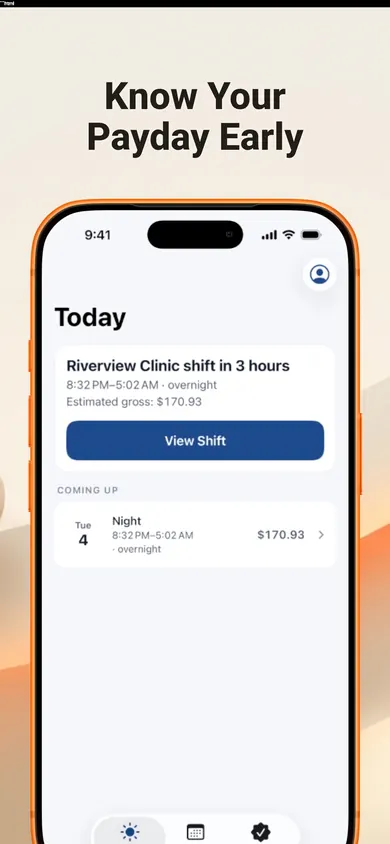
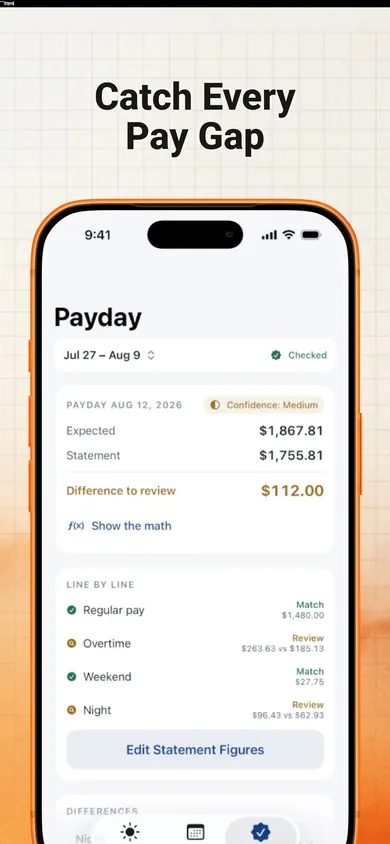
Design decision: scheduled shifts are never counted until you confirm them, so the estimate reflects what you worked, not what was planned. Honest limit: EarnCheck estimates gross pay from the hours and rules you enter. It doesn't calculate taxes, isn't a payroll system and doesn't give legal advice. A difference is something to review, not proof of an error. Night, weekend and holiday premiums you define are part of EarnCheck Pro; the free version covers one job, a full first pay period and weekly overtime.
Pick something else if you're salaried and exempt from overtime, or you need your employer's official timekeeping record. EarnCheck is your own independent record.
Keep your own record of every night
No account, no bank login, no employer login. Records stay on your iPhone, and you can try a sample payday before entering anything.
More free tools and guides
- How is holiday pay calculated?How is holiday pay calculated? Hours worked × your rate × your employer's holiday multiplier, then overtime by workweek. Pick your situation, see the math.
- Is overtime weekly or biweekly?Overtime under U.S. federal law is counted per workweek, not per biweekly pay period. Drag the hours, see the dollar gap, then check your rules.
- Does shift differential count for overtime?Yes. Under U.S. federal law a night or shift differential goes into your regular rate, so it raises your overtime pay. See the math in 10 seconds.
- What to do if your paycheck is shortPaycheck short? Line up your hours by workweek, compare the stub line by line, rule out cutoff dates, then ask payroll. Free gap finder and message draft.