For hourly and shift workers. Drag five steps into the order you'd take them, then check ours.
Drag the dots, or use the arrows1 of 5 in our order
Ask payroll in writing
Line up hours by workweek
Call the labor office
Rule out cutoff dates
Compare the stub line by line
Green edge = same spot as ours.
Free on iPhone
Updated November 2026 · By the Honest Little Apps studio · Not legal advice
What should you do if your paycheck is short?
Don't call anyone yet. First rebuild your hours by workweek, compare them with each line of the pay stub, and rule out timing reasons like cutoff dates. If a gap is still there, ask payroll in writing, calmly. Go to your state labor office or the Department of Labor only if that doesn't fix it.
That order matters because most short paychecks have a boring explanation, and the ones that don't are much easier to fix when you arrive with numbers instead of a feeling.
Line up your hours by workweek
Write down every shift: start, end, unpaid break. Group them by your employer's workweek, which can start on any day and doesn't have to match the pay period. Federal overtime is counted per workweek, not per paycheck.
Compare the stub line by line
Regular hours against regular hours, overtime against overtime, premiums against premiums. Compare gross with gross; taxes and deductions are a separate question.
Rule out the easy explanations
A shift after the payroll cutoff often lands on the next check. A workweek that straddles two pay periods splits its hours. A rate change may start mid-period.
Ask payroll in writing
Short, neutral, specific: the dates, the hours you recorded, the hours paid, the difference. A written message leaves a record and is easier for payroll to check. Our gap finder below drafts one.
Go to the labor office if it isn't fixed
The Department of Labor's Wage and Hour Division takes calls at 1-866-487-9243 and says complaints are confidential. Many states run their own wage office too; the DOL keeps a list of state labor offices.
Most short paychecks are timing, not theft, so bring numbers first and a complaint second.
Find the gap: paycheck short calculator
Enter the hours you worked in each workweek of a two-week pay period and what the stub paid. The table splits regular from overtime the way the federal 40-hour rule does, and drafts a calm message you can edit.
Line
You worked
Stub paid
Status
The math follows the U.S. federal rule: overtime is at least 1.5 times the regular rate for hours over 40 in a workweek, per the Department of Labor's Fact Sheet 23 (revised October 2019). Some states, California among them, add daily overtime. Tipped workers are a special case: the DOL's Fact Sheet 15 says that when an employer takes a tip credit, overtime is calculated on the full $7.25 minimum wage, not the $2.13 cash wage.
Split your hours by workweek before you compare totals, or a real overtime gap can hide inside a normal-looking 80.
The honest limits of this page
We can show you where hours and dollars don't line up. We can't tell you that you were underpaid. Salaried and exempt roles follow different rules, union contracts can set better terms, and your state may add protections we don't cover here. A difference is something to review, not proof of an error.
Timing also matters if it turns out you were owed money. The DOL's Handy Reference Guide to the FLSA says "generally, a 2-year statute of limitations applies to the recovery of back wages," and three years for willful violations. And employers have to keep records too: Fact Sheet 21 (revised July 2008) says payroll records must be kept at least three years, and time cards two.
Speaking up is protected. The DOL's Fact Sheet 77A says the law makes it illegal to fire or discriminate against an employee for filing a complaint, and notes that "most courts have ruled that internal complaints to an employer are also protected."
The $37 that was really a Tuesday
A warehouse picker at $18.50 an hour works 44 hours one week and 36 the next. The stub says 80 regular hours, $1,480 gross. By workweek, four of those hours were overtime: 76 regular plus 4 at time and a half is $1,517. Thirty-seven dollars short.
Her first message to payroll had the dates and both numbers, nothing else. The reply: the system had been set to a Sunday workweek, but the site runs Tuesday to Monday. Fixed on the next check. This story is an illustration; the arithmetic is real and checked in code.
The fastest fix is a short message with two numbers in it.
What EarnCheck does with the same paycheck
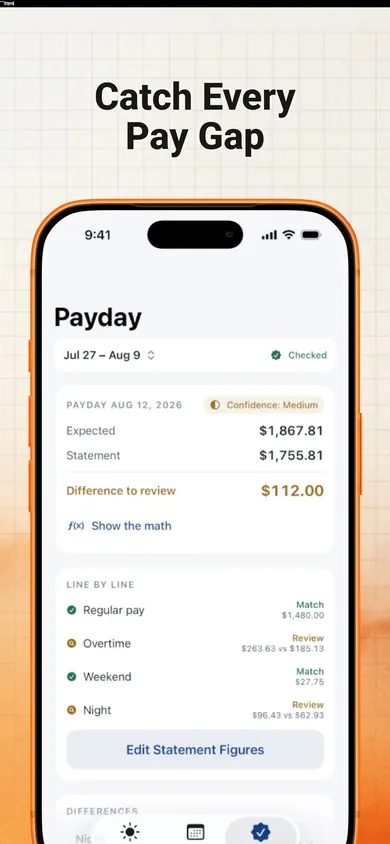
We built EarnCheck so step one and step two take minutes, not an evening. Confirm a finished shift in one tap; overnight shifts stay one shift even when they cross midnight. Set your employer's real workweek, pick the U.S. federal 40-hour rule, Ontario's 44-hour rule or your own agreement, and tap Show the Math to see the hours, rates and overtime behind every amount. On payday, enter the stub figures and each line is marked Match, Difference to Review or Incomplete Information.
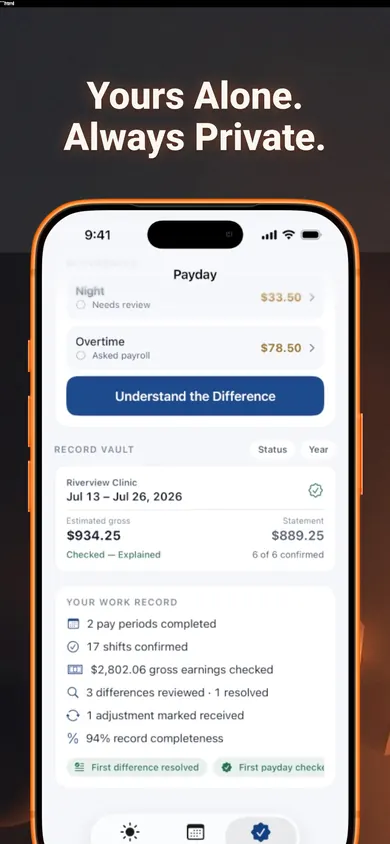
Payday, line by line: Match or Review.Record Vault keeps each checked period.
It also copies an editable, neutral message for payroll, and it never contacts your employer. Records stay on your device, with no account and no bank or employer login. The free version covers one job, a complete first pay period with unlimited shifts, weekly overtime and a payday comparison; EarnCheck Pro adds unlimited pay periods, multiple jobs and premium rules.
Who should use something else
Salaried or exempt employees. EarnCheck estimates pay from hours you enter, so it fits hourly and shift work best.
Anyone who needs net pay or tax answers. EarnCheck doesn't calculate taxes or deductions; the IRS Tax Withholding Estimator is the tool for withholding.
People who want someone to act for them. EarnCheck is not a payroll system or legal advice. A wage claim goes through your state labor office or the Wage and Hour Division.
Workers whose time clock app already shows weekly overtime they trust. You may not need a second record.
Short paycheck questions
How long does an employer have to fix a short paycheck?
It depends on your state. State payday laws set when wages are due, so your state labor office is the place to ask. If it was a mistake, payroll will usually fix it on the next check once you show the numbers.
Why is my paycheck missing hours from last week?
The most common reason is a payroll cutoff: shifts after the cutoff date are paid on the following check. A workweek that straddles two pay periods can also split one week's hours across two stubs.
Can I get in trouble for asking about a short paycheck?
Federal law bars employers from firing or discriminating against employees for filing a wage complaint, and the DOL notes that most courts also protect internal complaints to an employer.
Should I keep my own record of hours?
It helps. Employers must keep time records, but your own dated record of shifts and breaks is what lets you spot a gap quickly and explain it clearly.
Know before payday, not after
Record each shift in one tap, check the stub line by line and keep the record. Get EarnCheck free and try a sample payday before entering anything.
Free on iPhone
More free tools and guides
Server pay stub explainedServer pay stub explained in plain words: cash wage, tip credit, charged tips, tip makeup, service charges, and why your check can be near $0.
Is overtime weekly or biweekly?Overtime under U.S. federal law is counted per workweek, not per biweekly pay period. Drag the hours, see the dollar gap, then check your rules.
Cleaning business scheduling checklist12 checks to run before you text a cleaning client "you're booked", plus a day planner that shows how many jobs really fit once you add buffers and drives.
Dog grooming no-show policyBuild a dog grooming no-show policy in 2 minutes: see what missed grooms cost a year, pick a deposit and notice window, and copy the wording.
 Solo Work Tools