
Solo Work ToolsOvertime basics

Is overtime weekly or biweekly?

For hourly workers paid every two weeks. Drag the slider: same 80 hours, different overtime.

Week 1: 30 hWeek 2: 50 h
Counted by workweek$1,700.00
If averaged over 2 weeks$1,600.00
Overtime lost to averaging: $100.00
· 1.5× after 40 h a week
Download on the App StoreFree on iPhone

Updated November 2026 · By the Honest Little Apps studio · Not legal advice

YouI get paid every two weeks. Is overtime calculated weekly or biweekly?
Short answer

Weekly. Under the U.S. Fair Labor Standards Act, overtime is owed for hours over 40 in a workweek, at not less than one and a half times your regular rate. The Department of Labor's Fact Sheet 23 (revised October 2019) says plainly: "Averaging of hours over two or more weeks is not permitted."

YouSo 30 hours one week and 50 the next isn't just "80 hours, no overtime"?
Answer

Right. Each week stands on its own. Week 2 has 10 overtime hours, even though the pay period totals exactly 80. At $20 an hour that's $1,700 gross instead of $1,600: a $100 difference on one paycheck.

YouWhen does my workweek start?
Answer

Whenever your employer fixed it. The DOL defines a workweek as "a fixed and regularly recurring period of 168 hours," and says it "may begin on any day and at any hour." It doesn't have to match your pay period or the calendar week, so ask payroll which day yours starts.

Overtime is counted one workweek at a time; the pay period is only when you get paid.

Which overtime rule applies to me?

Most U.S. hourly workers fall under the federal weekly rule, but a few situations change the math. Tap through four questions.

Where do you work?

Do you work at a hospital or residential care facility that agreed an "8 and 80" schedule with you in advance?

Do you work in California?

Federal weekly rule. Overtime after 40 hours in each fixed workweek, at least 1.5× your regular rate. Hours can't be averaged across a biweekly pay period. Your state can add rules on top, never fewer protections, so check your state labor department too.

Source: DOL Fact Sheet 23.

Daily and weekly. California's Labor Commissioner says overtime is due over 8 hours in a workday or 40 in a workweek, at 1.5×, and double time over 12 hours in a workday. A biweekly total still doesn't average anything away.

Source: California DIR overtime FAQ.

The 8 and 80 system. Hospitals and residential care establishments may use a fixed 14-day period instead of the workweek, paying 1.5× for hours over 8 in a workday and over 80 in the 14 days, but only with a prior agreement with employees.

Source: DOL Fact Sheet 54 (revised July 2009).

Ontario: 44 hours. Most employees get overtime after 44 hours in a work week at 1½ times the regular rate. Unlike the U.S. rule, Ontario allows a written averaging agreement over two to four weeks.

Source: Ontario ESA guide (updated February 2026).

Check your local labour authority. We only cover U.S. federal rules, California and Ontario here. Your employment contract or collective agreement may also set better terms.

Not every job is covered. Some salaried roles are exempt from overtime, and Fact Sheet 23 notes the requirement "may not be waived by agreement between the employer and employees."

Two weeks at the clinic

A night-shift aide picks up three extra shifts in the second week of a pay period: 32 hours, then 48. The stub shows 80 regular hours at $19.50 and no overtime line. By the weekly rule, 8 of those hours should have paid time and a half: $1,638 gross, not $1,560.

That $78 might have an explanation. Some clinics use 8 and 80, for instance. The point is to know which rule you're on before payday, not after. This story is an illustration; the arithmetic is checked.
What EarnCheck can and can't tell you

We built EarnCheck to answer this exact question with your own shifts. You set your employer's real workweek, even when it differs from your pay period, and pick a preset: Ontario's 44-hour weekly rule, the U.S. federal 40-hour rule, or your own agreement. Each preset links to its official source and lists its exceptions. Tap Show the Math to see the hours, rates and overtime behind every amount.

The honest limits: EarnCheck estimates gross pay from the hours and rules you enter. It does not calculate taxes or deductions, is not a payroll system and does not give legal advice. A difference is something to review, not proof of an error. Daily overtime, double time and night, weekend or holiday premiums are part of EarnCheck Pro; the free version covers one job, a full first pay period, weekly overtime and a payday comparison.

Pick something else if your employer's time clock app already shows weekly overtime you trust, or if you need a tool that files a wage claim for you. EarnCheck never contacts your employer.

Ways to check overtime on a biweekly paycheck

MethodGood atMisses
Pay stub aloneShows what was paidRarely shows which week the hours fell in
Paper notebookFree, always on youYou do the weekly split and the 1.5× math
SpreadsheetFlexible formulasOvernight shifts and workweek start days get fiddly
EarnCheck (ours)Your workweek, line-by-line payday checkNo taxes or deductions; manual shift entry

What it looks like on iPhone

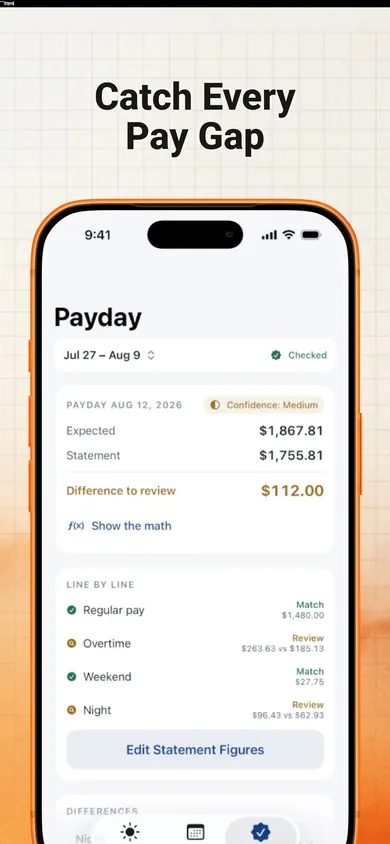
EarnCheck payday screen comparing expected and statement pay line by line, with overtime marked for reviewovertime flagged
Payday, line by line: Match or Difference to Review.
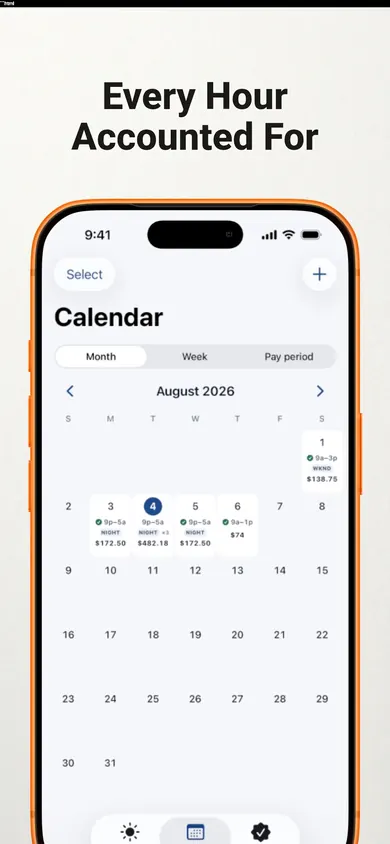
EarnCheck calendar showing confirmed shifts with hours and estimated amounts by dayovernights stay one shift
Shift Calendar: hours and estimates by day.

Overtime and pay period questions

Can my employer average overtime over two weeks?

Not under the federal FLSA. The Department of Labor says averaging hours over two or more weeks is not permitted. The 8 and 80 system for hospitals and residential care, agreed in advance, is a separate exception.

What if my workweek straddles two pay periods?

Overtime still follows the workweek. Hours from one workweek can land on two different paychecks, which is a common reason a stub looks wrong when it isn't, and a good thing to check first.

Does 80 hours in a pay period mean no overtime?

Only if each workweek was 40 hours or less. A 30-and-50 split still has 10 overtime hours in the second week under the federal rule.

Check your next payday, week by week

Set your workweek, confirm shifts in one tap, then compare gross with gross. Try a sample payday before entering anything.

Download on the App StoreFree on iPhone · Try it tonight

More free tools and guides