 Solo Work ToolsTipped work
The 3-minute server stub decoder
For servers, bartenders and other tipped workers. Pick what your stub is doing; we'll point to the terms.
Updated November 2026 · By the Honest Little Apps studio · Not tax or legal advice
Solo Work ToolsTipped workFor servers, bartenders and other tipped workers. Pick what your stub is doing; we'll point to the terms.
Updated November 2026 · By the Honest Little Apps studio · Not tax or legal advice
Because the paycheck is mostly the cash wage, and the taxes on all your tips come out of it. Under federal law an employer that takes a tip credit can pay as little as $2.13 an hour, and Social Security and Medicare on your reported cash and card tips are withheld from that same check. A near-$0 check can be correct.
Here's how that looks on one week's stub. The numbers below are an example we checked in code: 32 hours at the $2.13 federal cash wage, plus $180 in reported tips. Scroll the terms and the matching line lights up.
Your tips are taxed through your paycheck, so a small check usually means the system is working, not failing.
The hourly pay your employer hands you, before tips. The federal minimum cash wage for tipped employees is $2.13 an hour, according to the Department of Labor's tipped minimum wage table (dated July 1, 2026). Many states set it higher.
The part of the minimum wage your employer counts your tips toward. Federally that's up to $5.12 an hour: $7.25 minus $2.13. Alaska, California, Minnesota, Nevada, Oregon and Washington, among others, require the full state minimum wage before tips, per the same DOL table.
Tips on credit and debit cards. Some restaurants pay them out in cash each night, others add them to the paycheck. Either way they're income, and IRS Publication 531 (December 2024) says to include in gross income all tips you receive directly and charged tips your employer pays you.
The cash tips you tell your employer about. Publication 531 says to report them by the 10th of the next month, unless your tips from one job are under $20 for the month.
Many point-of-sale systems ask you to declare cash tips at clock-out; that's how they reach the stub.
Tips shared among staff, like a server tipping out the bar and bussers. Your share counts as your tip income. The DOL's Fact Sheet 15 says employers, managers and supervisors can't keep any part of employees' tips, directly or through a pool.
Cash wage plus every tip on the stub. It's the number taxes are figured from, which is why it's much bigger than the check.
The IRS lists the employee share at 6.2% for Social Security and 1.45% for Medicare in Topic 751: 7.65% together. On the example stub that's 7.65% of $248.16, or $18.98, and all of it comes out of the $68.16 wage.
A line that subtracts the tips you already took home, so they aren't paid twice. It's why the net looks tiny: those dollars were paid on the floor, not on the check.
What's left. If tax on your tips is more than your cash wage, the check can be $0. Publication 531 says any tax your pay was too small to cover can come out of your next paycheck, and anything still uncollected at year-end shows in box 12 of your W-2.
Extra pay when cash wage plus tips doesn't reach the full minimum wage for the workweek. Fact Sheet 15 says an employer taking a tip credit must make up the difference. Example: 32 hours with only $120 in tips is $188.16, short of 32 × $7.25 = $232; the top-up is $43.84.
With a tip credit, overtime is figured on the full $7.25, not the $2.13 cash wage, per Fact Sheet 15. That's $10.875 an hour minus the $5.12 credit: about $5.76 in cash wage for each overtime hour, not $3.20.
A fee the restaurant adds, like 18% on large parties. Publication 531 is plain: service charges paid to you are wages, not tips. They go through payroll like regular wages, not as tips.
For 2025 through 2028, the IRS says employees may deduct qualified tips up to $25,000 a year, phasing out above $150,000 of modified adjusted gross income ($300,000 joint), per its fact sheet on the new deductions. It's an income tax deduction at filing time; it doesn't change the stub math above.
Read a server stub top to bottom: wage, tips, gross, taxes, tips already paid, then net.
Accurate for card tips. Usually doesn't show your workweek or overtime.
Shows what was paid, not whether your clock-ins match the hours.
Free, but you do the workweek split and the overtime rule yourself.
Your own record of shifts and hours, compared line by line with the stub.
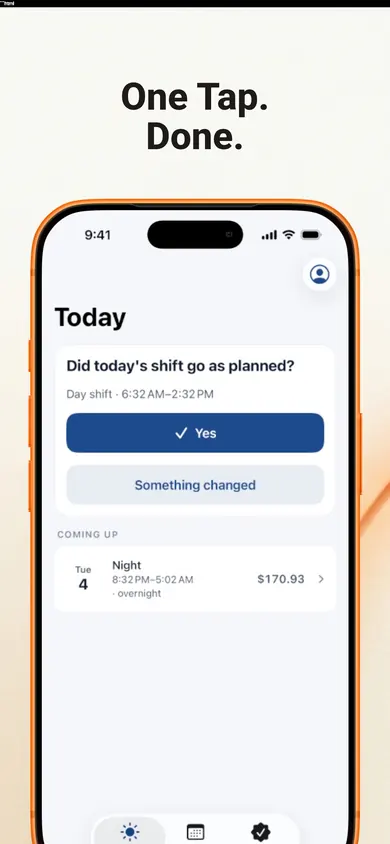
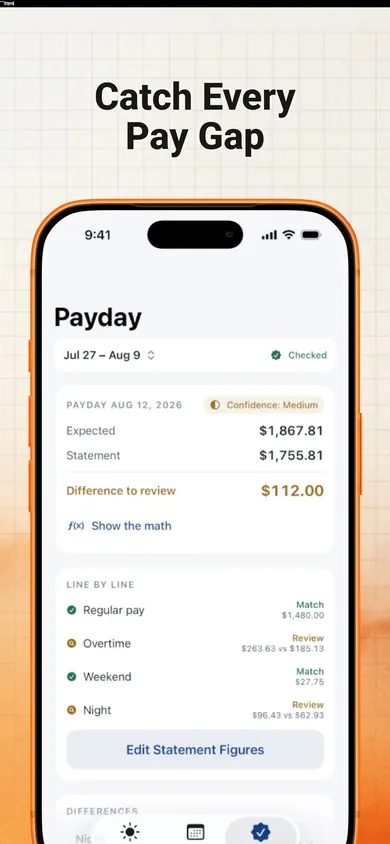
We built EarnCheck to answer one question: were my hours paid the way my rules say? You confirm each shift in one tap, overnight shifts stay one shift, and on payday you enter the stub's figures. Regular, overtime and premiums are each marked Match, Difference to Review or Incomplete Information.
The limits, plainly. EarnCheck doesn't record tips, and it doesn't calculate taxes or deductions; deductions are kept separate and never counted as missing pay. It multiplies the rate you enter, so if you work over 40 hours under a tip credit, check the overtime line by hand using the rule above. It's not a payroll system or legal advice, and a difference is something to review, not proof of an error.
Records stay on your phone, with no account and no employer login, and Face ID App Lock is there if you want it. The free version covers one job and a complete first pay period with unlimited shifts.
Confirm each shift as you clock out, then check the stub's regular and overtime lines on payday. Try it tonight with a sample payday before entering anything.