 Solo Work Tools
How is holiday pay calculated?
Holiday pay is calculated as the hours you worked on the holiday × your base rate × your employer's holiday multiplier (often 1.5 or 2), plus any paid-holiday hours you didn't work at your base rate. Overtime is then checked separately, by workweek, using only hours you actually worked.
That is the shape of almost every U.S. holiday paycheck. What changes is the multiplier, and who sets it. The U.S. Department of Labor's holiday page says the Fair Labor Standards Act "does not require payment for time not worked, such as vacations or holidays," and its overtime fact sheet #23 says the law doesn't require overtime pay for holiday work "as such." So the multiplier comes from your handbook, union contract or state law, not from federal law.
Holiday pay, step by step
Six steps, in the order a payroll team works through them. Each one has the formula you can check against your stub.
Find the rule that applies to you
Look in your handbook, offer letter or union contract for "holiday premium" or "holiday pay." Then check your state. Rhode Island's labor rules, for example, require at least 1½ times the normal rate for Sunday and holiday work for most employers (RI DLT regulation, 2025).
rule = contract or state law, whichever pays more
Split worked hours from paid-off hours
A paid holiday you take off and a holiday shift you work are two different lines. Mixing them up is the most common reason a holiday check looks wrong.
worked hours ≠ paid holiday hours
Price the holiday shift
Multiply the hours you worked on the holiday by your base rate and the multiplier. At $18 an hour and time and a half, an 8-hour shift is 8 × $18 × 1.5 = $216.
holiday shift = hours × rate × multiplier
Add the paid day off, if you have one
A paid holiday you didn't work is usually your normal day's pay: 8 × $18 = $144. The DOL's Hours Worked Advisor says paid holiday time "is not hours worked and need not be included" when counting toward overtime.
paid holiday = hours × base rate
Check overtime by workweek
Federal overtime is owed for hours worked over 40 in a workweek, and hours can't be averaged across two weeks (DOL fact sheet #23). Count holiday hours you worked; leave out paid holiday hours you didn't.
OT hours = worked hours − 40 (if above 0)
See if the premium counts toward overtime
Under 29 U.S.C. § 207(e)(6) and (h)(2), a holiday premium of at least 1½ times can be credited toward overtime owed in the same week. Some employers pay both anyway. Your stub will show which.
credited: max(holiday extra, OT extra)
Short version: price the shift, add any paid day off, then check overtime by workweek using worked hours only.
A worked example: Thanksgiving week at $18 an hour
A server works 8 hours on Thanksgiving at time and a half, plus 36 hours across the rest of the week. That is 44 hours worked, so 4 are overtime. Here is how the three common payroll policies land, worked out in our calculator below.
| Policy | How it's figured | Gross |
|---|---|---|
| Federal floor only | 44 h × $18 + 4 OT h × $9. No holiday premium required. | $828.00 |
| Holiday premium, credited | 44 h × $18 + the larger of the $72 holiday extra or the $36 OT extra. | $864.00 |
| Holiday premium, stacked | 44 h × $18 + $72 holiday extra + $36 OT extra. | $900.00 |
Gross pay before taxes and deductions. Tips are separate from these figures.
The same week can be $72 apart depending on one line in your handbook. That line is worth reading before the holiday, not after payday.
What this page can't tell you
- Your employer's holiday policy. Only your handbook, contract or payroll team can confirm it.
- Every state's rules. We cite Rhode Island and Ontario because their rules are specific and public; most U.S. states leave holiday premiums to the employer.
- Tips, taxes and deductions. These figures are gross wages only.
- If you're exempt from overtime. Salaried exempt staff follow different rules.
How EarnCheck checks a holiday paycheck
- Confirm the shift. Tap once when it ends, or adjust start, end and unpaid break. Overnight shifts stay one shift, even past midnight.
- Set your rules. Start from the U.S. federal 40-hour rule, Ontario's 44-hour rule or your own agreement, with your employer's real workweek. EarnCheck Pro adds daily overtime, double time and holiday premiums you define.
- Compare on payday. Enter the lines from your pay statement. Regular is matched with regular, overtime with overtime, premiums with premiums, and each line is marked Match, Difference to Review or Incomplete Information.
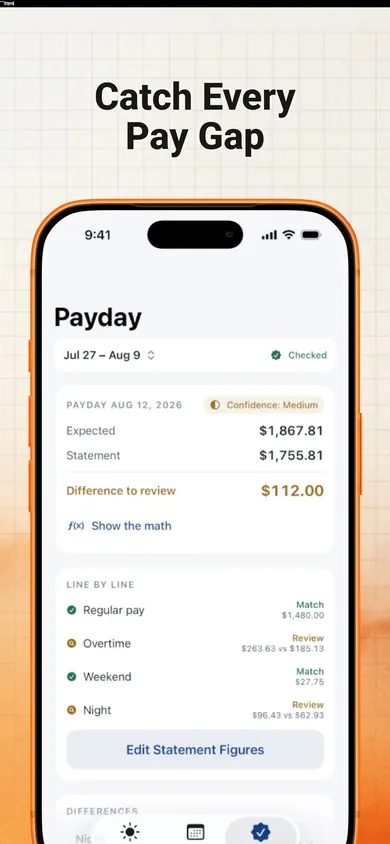
One design decision we made on purpose: EarnCheck never counts a scheduled shift until you confirm it, so a holiday you were scheduled for but swapped never shows up as pay you're owed.
Holiday pay questions
Is holiday pay required by law?
Not under federal law. The Department of Labor says the FLSA does not require payment for holidays not worked, and does not require a premium for working one. Some states, such as Rhode Island for Sunday and holiday work, and provinces such as Ontario do set rules.
Is holiday pay time and a half or double time?
Whichever your employer or contract sets. Time and a half is common; double time is less so. Federal law requires neither for holiday work itself, only overtime after 40 hours worked in a workweek.
Do paid holiday hours count toward overtime?
Not under the FLSA. The DOL says paid holiday time off is not hours worked and need not be counted toward the 40. Hours you actually work on a holiday do count.
How is public holiday pay calculated in Ontario?
Ontario's guide says public holiday pay is the regular wages you earned in the four work weeks before the holiday week, plus vacation pay payable for those weeks, divided by 20. If you agree to work the holiday, one option is public holiday pay plus 1½ times your regular rate for the hours worked.
Why does my holiday check look short?
The usual reasons are a paid holiday and a worked holiday being mixed up, a holiday premium credited against overtime instead of stacked, or the holiday falling in a workweek that splits across two pay periods. Line up your hours by workweek before asking payroll.
Who should pick something else
- If you think you were underpaid and want a ruling, contact the Wage and Hour Division or your state labor office. An app can't decide that.
- If you run payroll for others, you need payroll software, not a shift tracker.
- If you're salaried and paid the same every period, a calculator like this adds little.
Holiday pay calculator
Enter your own week. Everything runs in your browser; nothing is sent anywhere.
Your numbers here are an estimate of gross pay from the rule you pick. Your payroll team confirms what actually applies.
Check this payday, line by line
Confirm your holiday shift tonight, then compare gross with gross when the stub arrives. You can try a sample payday before entering anything.
More free tools and guides
- Does shift differential count for overtime?Yes. Under U.S. federal law a night or shift differential goes into your regular rate, so it raises your overtime pay. See the math in 10 seconds.
- What to do if your paycheck is shortPaycheck short? Line up your hours by workweek, compare the stub line by line, rule out cutoff dates, then ask payroll. Free gap finder and message draft.
- Is overtime weekly or biweekly?Overtime under U.S. federal law is counted per workweek, not per biweekly pay period. Drag the hours, see the dollar gap, then check your rules.
- Server pay stub explainedServer pay stub explained in plain words: cash wage, tip credit, charged tips, tip makeup, service charges, and why your check can be near $0.